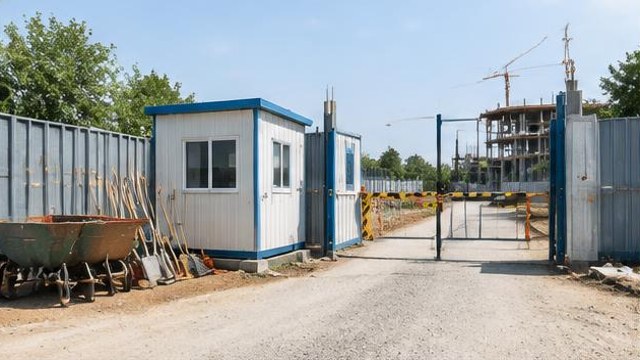
Before a single brick is laid, a site has to be fenced, signed and organised, because the first few weeks set the tone for safety, security and discipline for the rest of the project. A hoarding of sheet metal or plywood, typically 2 to 2.5 m high, is put up along the site boundary facing the road to stop unauthorised entry, keep dust and debris away from the public, and display the mandatory project signboard listing the Real Estate Regulatory Authority (RERA) registration number, the promoter's name, sanctioned plan approval details, and the local authority's permit number, since most state RERA rules and municipal byelaws require this to be visible to the public.
The site office is usually a prefabricated cabin or a temporary shed housing the project manager, site engineers, billing engineer and visitors' area, along with a drawing rack and a notice board for safety instructions and statutory licences such as the Building and Other Construction Workers (BOCW) Act 1996 registration and labour licence. Stores are a separate, lockable structure for cement, steel, fittings and consumables, raised on a plinth to keep moisture out, with cement stacked on wooden dunnage away from walls and steel sorted by diameter and tagged by supplier test certificate to avoid mix-ups during billing and quality checks.
A labour camp, where migrant workers are housed on or near site, must meet basic standards under the BOCW Act 1996 and the Contract Labour (Regulation and Abolition) Act 1970 — adequate drinking water, toilets, bathing areas, a creche if women with children under six are employed, and first-aid facilities. Many developers now avoid on-site camps in dense urban areas and instead arrange transport from a nearby labour colony, but wherever labour is housed, the principal employer remains responsible for verifying that the contractor maintains these welfare facilities and registers workers for Employees' Provident Fund (EPF) and Employees' State Insurance (ESI) as applicable.
Temporary water and power connections are arranged early, since curing, mixing and even basic site lighting cannot wait for the permanent utility connection. A bore well or tanker-fed water storage tank with a pump, and a temporary electricity connection from the local distribution company (or a diesel generator as backup) are typically commissioned in the first week of mobilisation, along with a water meter or sub-meter if the developer is billed separately for construction water use.
Typical hoarding height
2-2.5 m
Key labour law
BOCW Act 1996
Statutory registration shown on signboard
RERA number
Remember on site
- Hoarding and project signboard must display RERA registration and sanctioned plan details as required locally
- Stores are raised on a plinth with cement on dunnage and steel sorted and tagged by test certificate
- Labour camp welfare facilities fall under the BOCW Act 1996 and Contract Labour Act 1970
- Temporary water and power are commissioned early since curing and site work cannot wait
Check yourself
What information must a construction site's project signboard typically display under most state RERA rules?
Why is cement stacked on wooden dunnage in site stores rather than directly on the floor?
Which law primarily governs welfare facilities like drinking water, toilets and creche at a labour camp?
Who remains ultimately responsible for verifying labour welfare facilities even when a contractor manages the camp?
Why is steel typically sorted by diameter and tagged with supplier test certificates in site stores?
What is a common backup arrangement for temporary power if the distribution company connection is delayed?
Which registrations should migrant construction workers typically be enrolled in by the contractor?
What is the main purpose of site hoarding along the boundary?
Under the BOCW Act 1996, what facility must typically be provided if women workers with children under six are employed?
Why might a developer prefer arranging transport from a nearby labour colony over an on-site labour camp in dense urban areas?