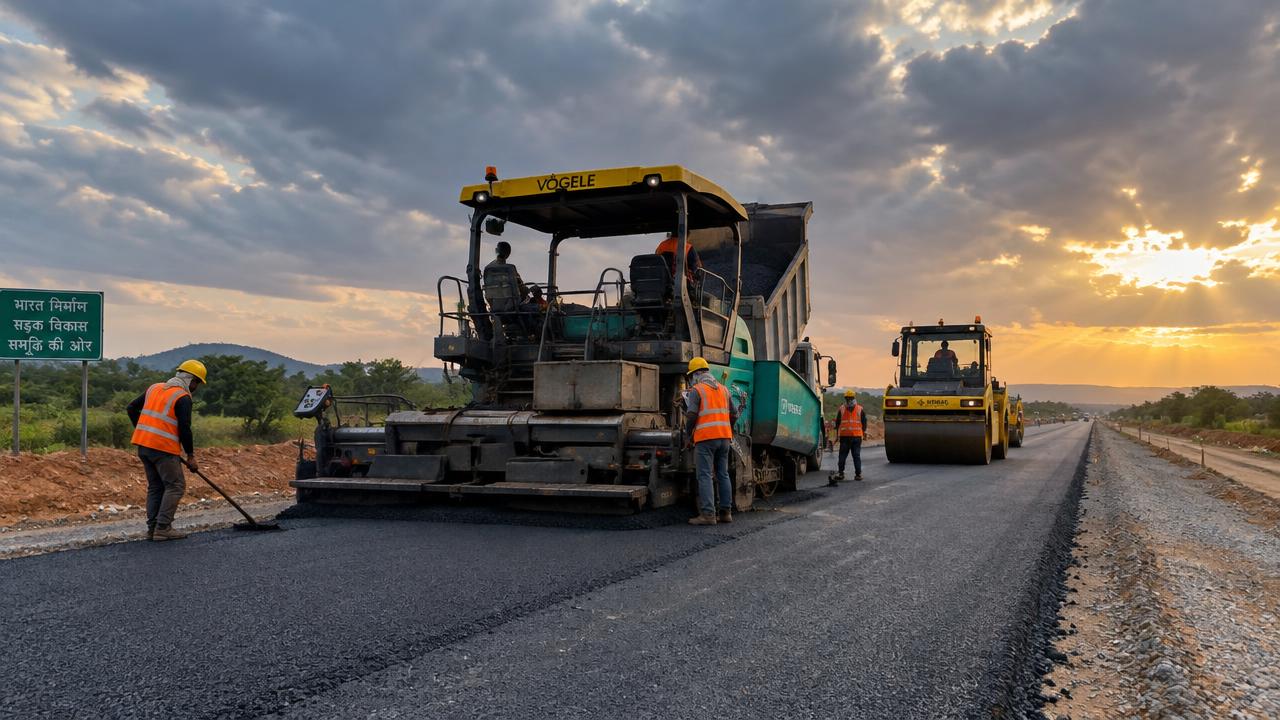
A flexible road pavement is not a single slab of black material; it is a layered system where each layer has a distinct job and progressively finer, stronger material as you move up from the ground. From bottom to top the typical layers are: subgrade (the prepared natural or improved soil), sub-base (granular sub-base, GSB), base course (often water-bound macadam, WBM, or wet mix macadam, WMM), binder course (dense bituminous macadam, DBM), and the surface or wearing course (bituminous concrete, BC, or a surface dressing/premix carpet on lower-category roads).
Each layer spreads and reduces the wheel load before it reaches the layer below, so a pavement is designed so that the weakest material (subgrade soil) only ever sees a small fraction of the original tyre pressure. Guidelines for the design of flexible pavements for Indian highways are given in IRC:37, which has gone through several revisions reflecting changed traffic levels (now expressed in msa — million standard axles — rather than simple traffic volume) and uses a mechanistic-empirical approach in its more recent versions.
Design begins with subgrade CBR (California Bearing Ratio) testing, which measures the soaked strength of the prepared subgrade soil; a lower CBR means a weaker subgrade, which in turn demands a thicker pavement above it to spread the load adequately. Site staff must ensure the subgrade is compacted and tested to the design CBR before any granular layer is laid — building a good pavement on a poorly compacted subgrade wastes every layer above it.
Flexible pavement design guideline
IRC:37
Design traffic unit
msa (million standard axles)
Subgrade strength test
Soaked CBR (California Bearing Ratio)
Remember on site
- Flexible pavements are layered: subgrade, GSB, WBM/WMM base, DBM binder, BC/premix surface — each layer reduces load reaching the one below.
- IRC:37 is the Indian guideline for flexible pavement design, using design traffic in msa (million standard axles).
- Subgrade CBR (soaked) is the starting input for pavement thickness design — weaker subgrade needs a thicker pavement.
- A poorly compacted subgrade undermines every layer built above it, however well those layers are built.
Check yourself
Which IRC code gives guidelines for flexible pavement design in India?
In what unit is design traffic expressed for flexible pavement design?
What does a lower subgrade CBR generally require?
What is the typical order of flexible pavement layers from bottom to top?
Why is subgrade compaction and CBR testing critical before laying granular layers?