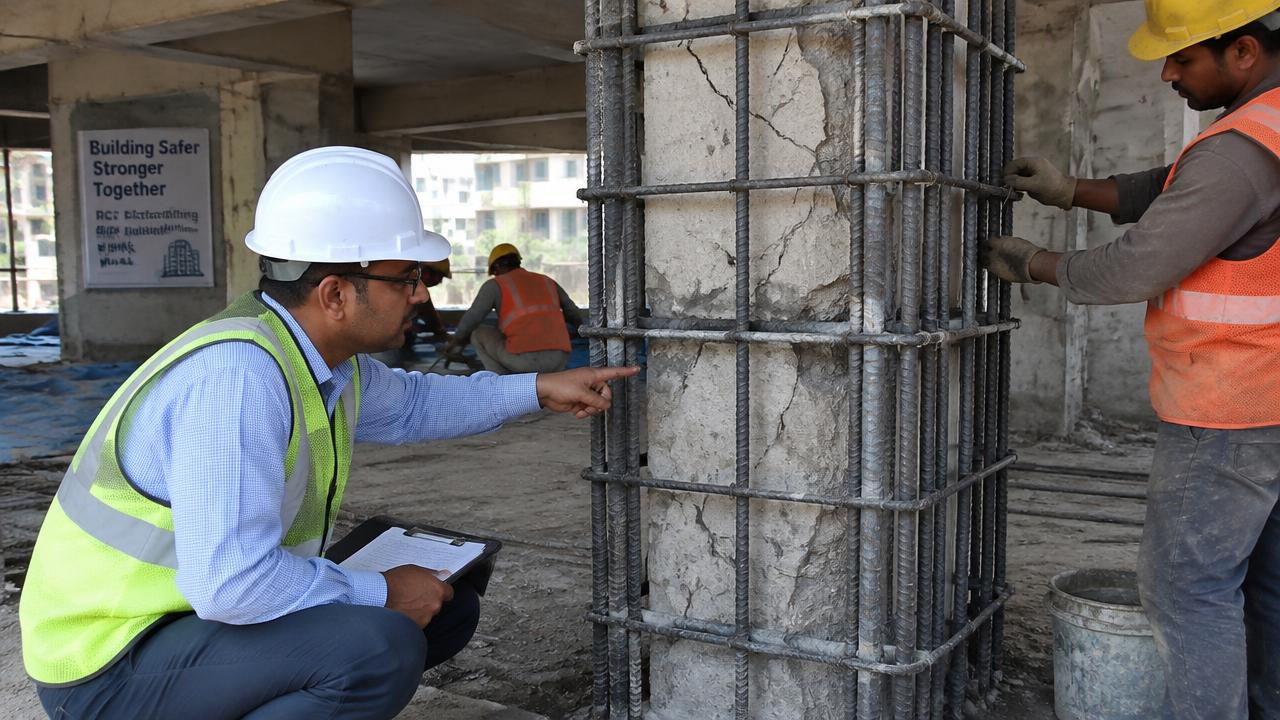
Before any repair or retrofit decision, a structured condition survey records visible distress (cracks, spalling, corrosion staining, dampness, deflection) mapped against the structural drawing, together with the building's age, past alterations, loading history and any prior repairs. This visual record is the foundation for deciding what further testing is needed — testing without first mapping the distress wastes effort on the wrong locations.
Non-destructive testing of concrete, as covered under IS 13311, includes the rebound hammer (gives a surface hardness index used to estimate relative concrete quality, not an absolute strength value) and ultrasonic pulse velocity, UPV (measures the time for a pulse to pass through concrete, flagging voids, cracking or poor compaction by a drop in velocity). Both methods are indicative and screening tools; where a definitive strength figure is needed for structural assessment, a core test (extracting and crushing an actual concrete core per IS 516) remains the reference method.
Corrosion assessment uses a half-cell potential survey to map the probability of active reinforcement corrosion across a slab or wall, and a cover meter to check actual reinforcement cover against the drawing; combined with a visual crack survey (longitudinal cracks along bars, rust staining, spalling) these tests let an engineer decide whether a member needs patch repair, jacketing or replacement.
NDT methods code
IS 13311 (Parts 1 & 2)
Core test reference code
IS 516
Remember on site
- Map visible distress against drawings first — testing follows diagnosis, not the reverse.
- Rebound hammer and UPV (IS 13311) are screening tools giving relative, not absolute, strength.
- A core test under IS 516 is the reference method when a definitive strength value is required.
- Half-cell potential and cover meter surveys assess corrosion risk and actual reinforcement cover.
Check yourself
What should be done before selecting NDT test locations?
What does the rebound hammer test estimate?
What does ultrasonic pulse velocity (UPV) testing detect?
Which method gives a definitive concrete strength value when needed?
What does a half-cell potential survey assess?