The compound wall and internal roads are often treated as an afterthought scheduled for the last month of a project, but they involve their own foundations, levels and drainage falls that need planning from the start, since getting them wrong means cutting into finished paving later. A compound wall typically needs its own shallow strip or column footing depending on height and soil, and must respect the setback line and ownership boundary shown in the approved survey plan, since a wall built even slightly on a neighbour's land or on a government road-widening margin can trigger a legal dispute or a demolition notice from the local authority.
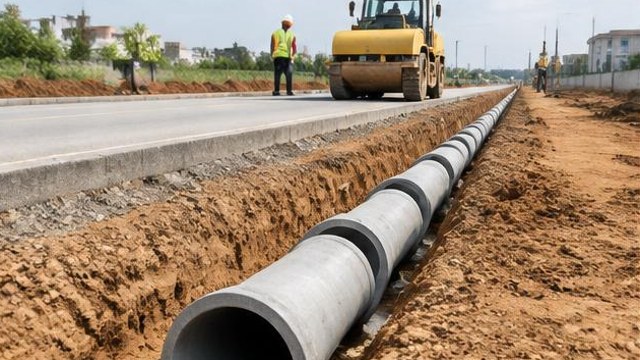
Internal roads and paved areas are built up in layers — typically a compacted sub-grade, a granular sub-base (GSB) or water-bound macadam (WBM) layer, and a wearing course of either cement concrete or asphalt (bitumen) depending on expected traffic and budget — with concrete preferred in India for internal society roads because it needs less maintenance than asphalt even though it costs more upfront. Paver blocks, usually interlocking concrete units laid on a sand bedding course over a compacted base, are popular for parking areas, walkways and driveways because individual blocks can be lifted and relaid if a service line underneath needs repair, which is far cheaper than breaking and redoing a cast-in-place pavement.
Storm water drainage must be designed before roads and paving are finalised, not after, because the slopes of paved surfaces and the levels of catch pits, channels and outfall points are all interdependent. Open or covered storm water drains run along road edges collecting surface runoff and carrying it through catch pits (which trap silt and debris) to either a municipal storm drain connection or, increasingly required by many state and city regulations, to on-site retention or percolation structures before any surplus is let out, so that the development does not simply dump rainwater onto an already overloaded public drainage system.
Rainwater harvesting has become a mandatory requirement in many Indian states and cities for plots above a certain size (the threshold varies by local building byelaws), typically through recharge pits or percolation wells that collect roof and surface runoff, pass it through a filter chamber to remove silt and debris, and let it percolate into the ground to recharge the water table, rather than running off entirely into the street. These are usually integrated with the site's storm water drainage layout so that runoff is directed into the recharge structures before any excess discharges off-site.
Paver block base
Sand bedding over compacted sub-base
Road layer example
Sub-grade + GSB/WBM + wearing course
RWH threshold
Varies by state/local byelaws
Remember on site
- Compound walls and roads need their own foundation design, levels and drainage falls planned from project start
- Roads are built in sub-grade, sub-base, and wearing course layers; concrete suits internal roads needing low maintenance
- Storm drainage design must precede finalising road and paving levels, with catch pits and defined outfall points
- Rainwater harvesting via recharge pits is mandatory above certain plot sizes under many state/city byelaws
Check yourself
Why must a compound wall's location respect the setback line and survey boundary carefully?
What is the typical layered structure of an internal road or paved area?
Why is paver block paving popular for parking areas and driveways?
Why should storm water drainage be designed before finalising road and paving levels?
What is the function of a catch pit in storm water drainage?
What is commonly used to construct rainwater harvesting structures on a plot?
Why do many state and city regulations now require on-site retention or percolation before discharging storm water?
Why is concrete often preferred over asphalt for internal society roads in India, despite higher upfront cost?
What determines whether rainwater harvesting is mandatory for a given plot in India?
What is water-bound macadam (WBM) typically used for in road construction?