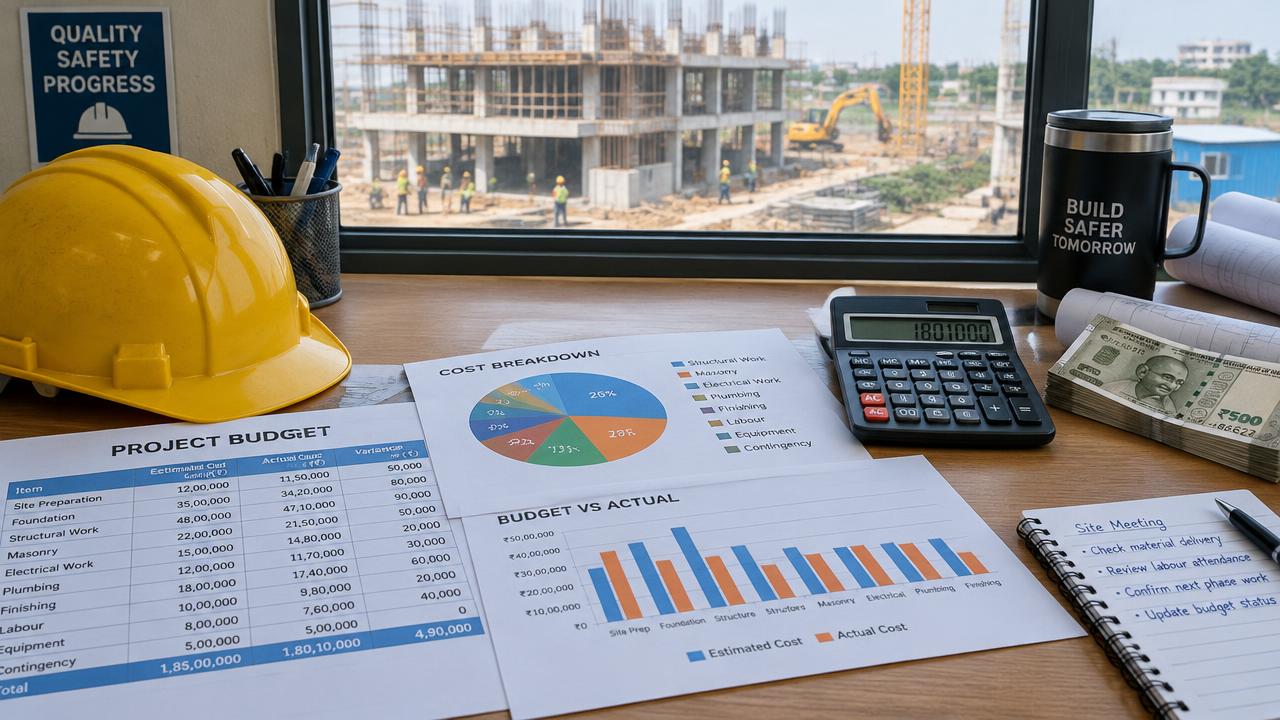
The bill of quantities (BOQ) prepared at tender or contract stage is the budget baseline: quantities, rates and the resulting cost for each item, element by element. Cost control is the ongoing comparison between this baseline and what is actually being spent or committed as the project proceeds — without this comparison, a project can look financially fine right up to the point money runs out, because invoices and commitments lag behind the physical work that has already consumed budget.
A practical cost control system tracks, item by item: BOQ budgeted quantity and rate, quantity executed to date, committed cost (orders placed, subcontracts awarded, even if not yet invoiced), and actual cost incurred (invoiced and paid). The gap between committed cost and BOQ budget for each item, summed across the project, gives early warning of overrun long before it shows up in the final account — waiting for the final account to discover overrun is far too late to act.
Cost overruns typically originate from a small number of recurring causes: quantity growth beyond the BOQ (scope creep or poor original measurement), rate escalation on items not fixed by the contract, rework from quality defects, and extended overheads from schedule delay. A disciplined site team tags every cost deviation to one of these causes as it is identified, because the corrective action is different for each — a quantity overrun needs a variation order, a rate escalation needs a contractual price adjustment claim, and rework needs a root-cause fix in the work method.
Cost control baseline
Contract BOQ (quantity × rate per item)
Key tracked cost states
Budgeted, executed, committed, actual
Remember on site
- The BOQ is the cost baseline; ongoing comparison against committed and actual cost — not just invoices — is what controls budget.
- Track budgeted, executed, committed and actual cost per item; the committed-vs-budget gap gives the earliest overrun warning.
- Waiting for the final account to reveal overrun is too late — real-time tracking against commitments catches it early.
- Tag every deviation to its real cause (quantity growth, rate escalation, rework, delay overheads) because each needs a different fix.
Check yourself
What is the budget baseline for project cost control?
Why is tracking committed cost (not just invoiced cost) important?
What does a gap between committed cost and BOQ budget for an item indicate?
Why should each cost deviation be tagged to its specific cause?
Which is NOT a typical recurring cause of cost overrun mentioned?