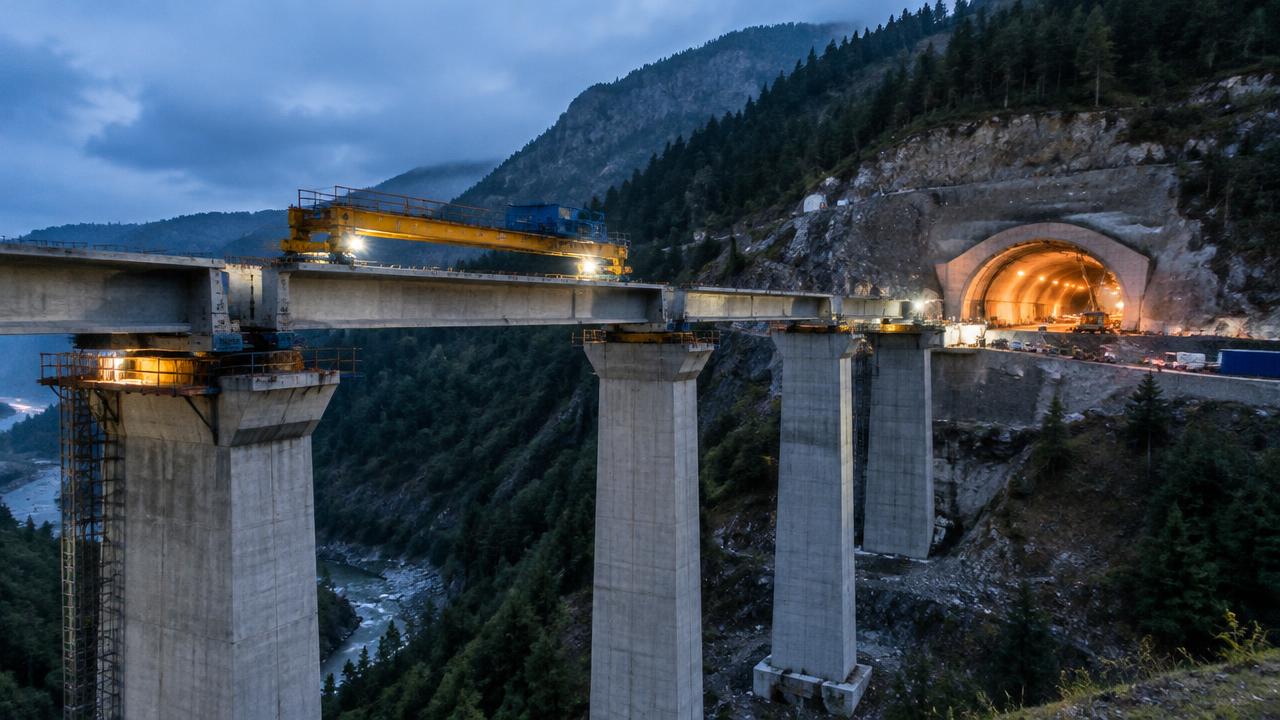
Highway bridges in India are designed for loads specified in IRC:6, which covers dead load, live load (standard vehicle classes such as Class A, Class AA and Class 70R, representing different categories of traffic from ordinary roads to heavy-duty routes), impact (a dynamic allowance for the jolting effect of moving vehicles), wind load, seismic load, temperature effects, and loads from water currents, floating bodies and ship impact where relevant.
Vehicle live load classes are chosen based on the category of road and the bridge's intended use; a bridge on a route also used by heavy multi-axle or defence loads must be checked for the corresponding load class, and a site engineer should always confirm the design live load class against the structural drawing rather than assume a standard class. Impact factor is applied to live load to account for dynamic effects of a moving vehicle crossing the span, and reduces with increasing span length since a longer span responds less dynamically to a given vehicle's bounce.
Seismic design of bridges follows IS 1893 (relevant part) in combination with IRC provisions, and the designer selects the governing load combination for each structural element; a site engineer's responsibility is not to recompute these loads but to ensure that reinforcement, bearings and expansion joints are installed exactly as detailed, because these components are precisely what carries the calculated loads into the substructure.
Bridge loading code
IRC:6
Standard live load classes
Class A, Class AA, Class 70R
Remember on site
- IRC:6 specifies bridge loading: dead, live (vehicle classes like Class A, AA, 70R), impact, wind, seismic, temperature and water/ship impact where relevant.
- The design live load class must match the route's intended traffic — always confirm this against the structural drawing.
- Impact factor reduces with increasing span length, reflecting lower dynamic response of longer spans.
- Reinforcement, bearings and expansion joints must be installed exactly as detailed — they carry the calculated design loads.
Check yourself
Which IRC code specifies loads for road bridges in India?
What do Class A, Class AA and Class 70R represent?
How does impact factor generally change with span length?
What should a site engineer confirm regarding live load class?
Why must bearings and expansion joints be installed exactly as detailed?