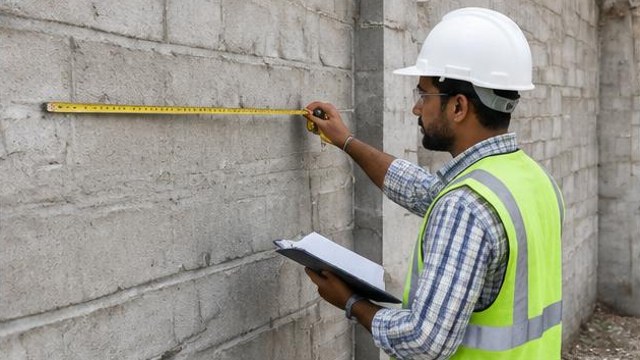
The Measurement Book, almost always called the MB, is the legal record from which every rupee paid to a contractor flows. In government works it is a numbered, page-controlled register issued by the department, while in private projects it is usually a bound site register or a digital equivalent, but the discipline is the same: no payment without a measurement, and no measurement without a dated, signed entry describing exactly what was measured, where, and by whom. Once an entry is made it is never erased; a wrong figure is struck through with a single line, corrected, and initialled, because the MB can be called for in audit or arbitration years later.
Good practice is to record measurements as the work is completed and before it is covered up, especially for items like foundation concrete, reinforcement, and plumbing or electrical conduits embedded in slabs and walls, which cannot be checked once concreted. The engineer-in-charge or the billing engineer measures jointly with the contractor's representative on site, takes level readings or tape measurements, and enters length, breadth, depth or number against each item exactly as described in the Bill of Quantities, with cross-references to the relevant drawing number and IS 1200 part for the method of measurement used.
A common mistake on site is to measure in bulk at the end of the month purely from memory or from the contractor's own claim sheet, which weakens the engineer's position if a dispute arises later and also makes it difficult to certify provisional or running quantities correctly. Another mistake is failing to record abstract calculations, meaning the working behind each quantity, so that a reviewing engineer six months later cannot reconstruct how a number was arrived at. The MB should always carry a check or test-check remark from a senior engineer for high-value or critical items, as required by most departmental codes and sound private-sector practice alike.
Measurement is not just an accounting exercise, it is also the first line of quality control, since the engineer walks the work before certifying it, and it protects the contractor too, because a properly recorded MB is admissible evidence if a client disputes a bill or delays payment. Treating the MB casually is one of the most expensive habits in Indian site administration.
Primary measurement code
IS 1200 (various parts)
MB correction method
single strike-through + initial
Remember on site
- No payment is made without a dated, signed Measurement Book entry
- Measure before work is covered, especially reinforcement, foundations and embedded services
- Never erase an entry; strike through, correct and initial
- Reference the BOQ description, drawing number and IS 1200 measurement method for each item
Check yourself
What is the Measurement Book (MB) used for?
How should a wrong entry in the MB be corrected?
Why should reinforcement be measured before concreting?
Which Indian Standard governs methods of measurement of building works?
Who typically takes joint measurements on site?
What is a common weakness of measuring in bulk from memory at month end?
What should accompany each MB entry besides the quantity?
What role does a senior engineer's test-check serve in the MB?
Why is the MB valuable in a legal dispute between client and contractor?
In private sector projects, what commonly substitutes for a government-issued MB?